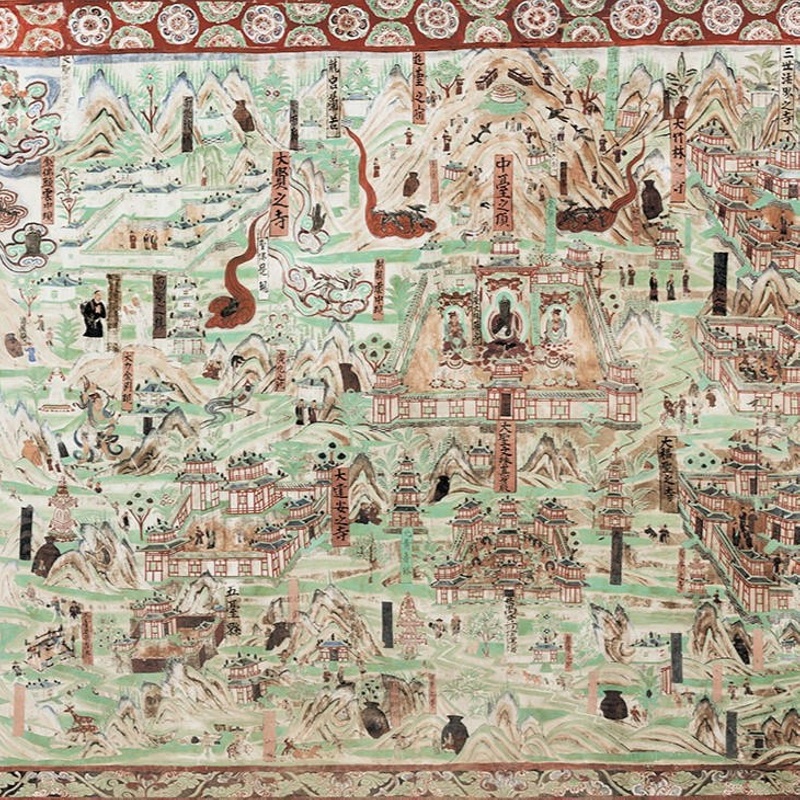
About this objectDunhuang, on the borders of many of the empires and kingdoms of northern China and central Asia, was an important stop on the Silk Roads and on the pilgrimage route westwards to the sacred sites of Buddhism. Rock-cut Buddhist temples were constructed here from the 4th century, the largest group southwest of the town. Over several centuries, hundreds of temples were excavated, painted and filled with statues.
Cave 61, excavated and decorated in the 10th century under the sponsorship of the king of the neighbouring kingdom, Khotan, was dedicated to the Mañjuśrī. The back or west wall—13.45 m wide —was illustrated with an image of Wutaishan (Five Terrace Mountain), a site in northern China believed to be his homeplace and a major pilgrimage site. The mural shows the numerous temples, stupas and shrines, with pilgrims travelling between them.
Date Made10th c.
PeriodGuiyijun
Place MadeDunhuang
Subject and Association KeywordsPilgrimage
Subject and Association KeywordsJourney
Subject and Association DescriptionLearn More: Ackermann et al. 2007; Cartelli 2012; DHA 2024:; UNESCO 1279; van Schaik and Galambos 2001;