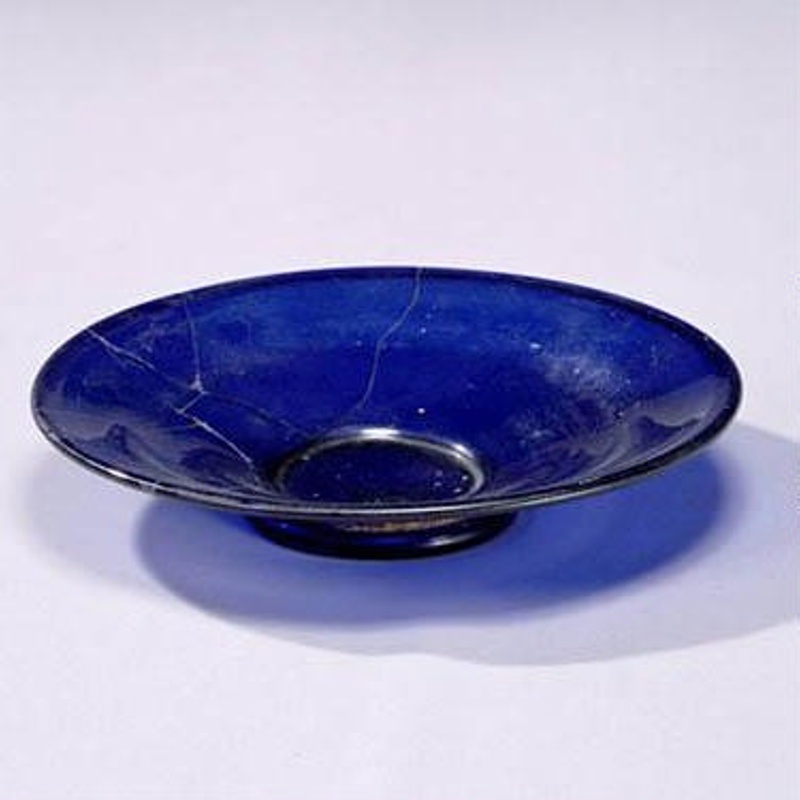
About this objectExcavated in 1963 from the the 5th century tomb No. 126 in the Niizawa Senzuka Tumulus Cluster at Kasahira, Nara, in Japan, this dish was found with a glass bowl [EXH134], placed together like a cup and saucer.
The dish has a ring base made by stretching the body, a common production technique observed in Roman glassware. it was produced by a free-blowing method, with a small pontil mark on its bottom surface. The inner surface show traces of a painting in gold with a bird, horse, and figure—although now almost entirely worn away. It is probable that the production and painting of the dish were conducted at different places or times.
Non-destructive X-ray fluorescence analysis was applied to a shard of blue-coloured glass in 2017, believed to be from this dish. This showed that the fragment's chemical composition is similar to the typical blue-green glassware produced in the imperial Roman period on the western side of the Euphrates. The golden painting on the inner surface of the dish is possibly an additional decoration applied during its eastward transportation.
Date Made1st-3rd century
PeriodRoman
Place MadeSyria
Subject and Association KeywordsGlass
Subject and Association KeywordsDeath and burials
Subject and Association DescriptionLearn More: Abe et al 2018