
Journey from Nara to Norwich
The Nara to Norwich project is an international collaboration exploring many aspects of the changes across Eurasia from around AD 500 onwards when Christianity and Buddhism respectively became established in societies at the edges of the Silk Roads: Britain and Scandanavia in northwest Europe, and Japan and Korea, in northeast Asia.
The origins of Buddhism and Christianity are found in south and west Asia respectively, but both religions spread in the centuries following the deaths of their founders finding new centres of faith in central Asia and southern Europe under the Kushan (1st–3rd centuries AD) and Roman (27 BC–5th century AD) empires. It was from these regions that the religions were then taken further, to the edges of Asia and Europe—to Nara and Norwich.

Explore the project


Exhibit of the month
Hyecho’s Travels, (往五天竺國傳, Wang Ocheonchukguk Jeon). Bibliothèque nationale de France, Pelliot chinois 3532
Hyecho (혜초/ 慧超), a Buddhist monk from Silla, kept an account of his multi-year, 20,000 km pilgrimage by sea and land to the sacred sites of India and beyond. This 8th century manuscript—往 五 天 竺 國 傳—written in Literary Sinitic (the official written language of China), recounts his journey as far as his return to the borders of China, where it was found.
Learn more about the exhibit.
Recently Released
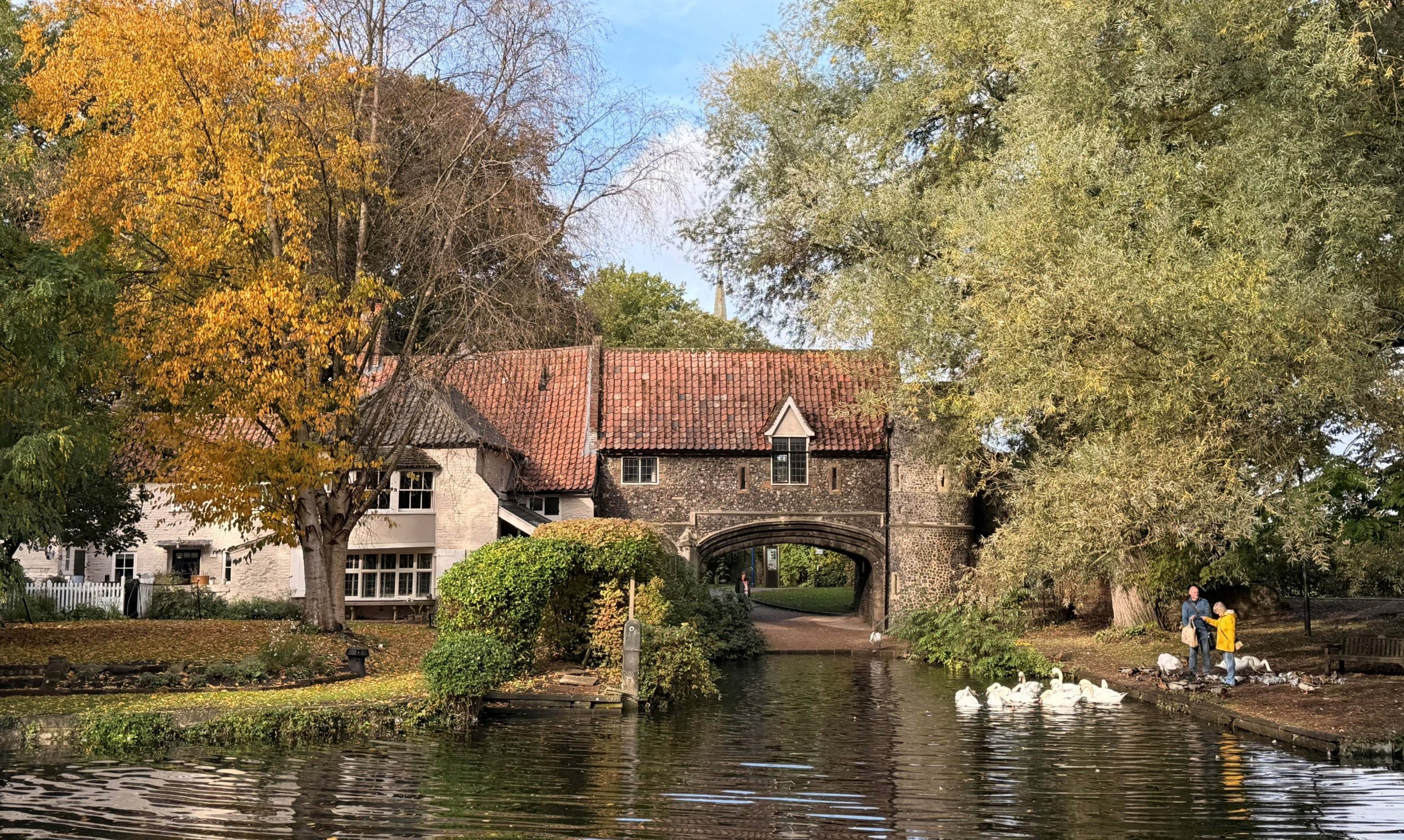
Walking the Walsingham Way: Norwich Cathedral
This is the first of a series of posts which will explore our walk of the Walsingham Way in more detail, with an emphasis on the differences in sensory experiences for the medieval and modem pilgrim. Revd. Canon Peter Doll welcomed the group at Prior’s Hall, Norwich Cathedral on 09 June 2026. Norwich Cathedral was the starting point for our walk of the historic pilgrimage route linking Norwich and Little Walsingham. Photograph: John Falconer. Our…

Bromholm Priory, Bacton, Norfolk: a forgotten medieval pilgrimage centre?
In this week’s post, Professor Katy Cubitt explores Bromholm Priory, an important and yet largely overlooked centre of pilgrimage in the medieval period that once housed a relic of the Holy Cross. In 1251, King Henry III made a pilgrimage to four major relic churches in East Anglia, visiting the shrines of St Edmund at Bury (Suffolk), of the relic of the Holy Cross at Bromholm (Norfolk), of the Virgin Mary at Walsingham (Norfolk) and…
Read More Bromholm Priory, Bacton, Norfolk: a forgotten medieval pilgrimage centre?

Sensing Sacred Spaces: Researching pilgrimage through a phenomenological approach
In this series, I will be exploring one of our key research areas for this project—the sensory experience of pilgrimage. This first post will delve into one of the methodological approaches we have used for this investigation, how it relates to the broader archaeological field and how this manifests in practice as we investigate the experience of pilgrimage. At locations like the ancient woodland of Wrongs Covert along the UK route, we experienced a spectrum…
Read More Sensing Sacred Spaces: Researching pilgrimage through a phenomenological approach